International Year of the Woman Farmer: West Africa Community of Practice
In celebration of the International Year of the Woman Farmer, we’re honored to share the stories of three women farmers. They are among so many women who have shown tireless effort and creativity, while advancing equity, in one of the most challenging areas of the world.
Houreye Boukari
From Seeds to Solutions: A Woman Farmer’s Journey to Improve Community Nutrition and Resilience in Niger
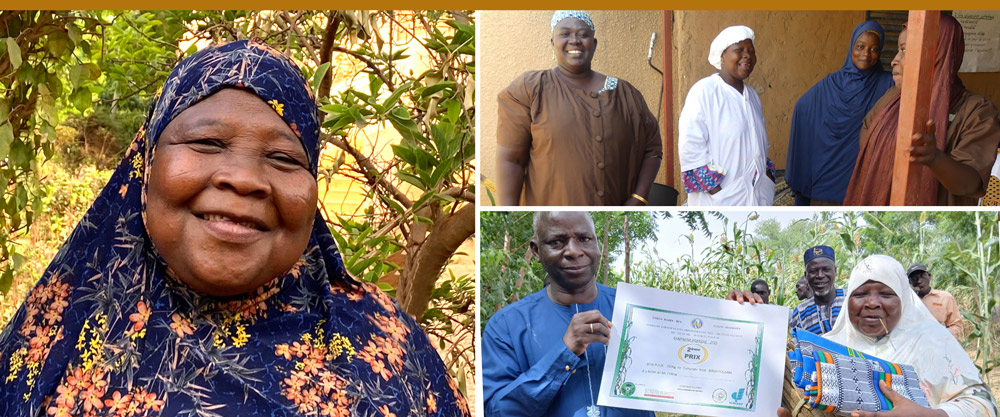
Clockwise from left: Houreye Boukari; Houreye with grain processors in Tera, Niger; Houreye receiving an award certificate.
Houreye Boukari is a female member of “Hareyben,” a Niger farmers’ union based in Tera. The Hareyben Union claims membership to the larger MOORIBEN federation. In her endeavors to improve and build greater resilience in this food-insecure context, Houreye does not only work as a farmer. She also collaborates with researchers to find locally adapted solutions to issues facing farming systems that she then helps to implement and share with members of her community.
Houreye is a strong leader in a network of women who work in local processing centres. In these centres, the women process nutritious flours using locally harvested cereals, legumes, fruits, non-timber forest products and vegetables. The women’s processing activities allow them to generate much-needed income for their groups. They sell the processed resources to help fight malnutrition among children and displaced populations, and to generate income for both farmer and processor groups. The remarkable positive shift as a result of these activities is magnified in Houreye’s following explanations: “Before, if a child was malnourished, you had to go to the health centre, and the midwife would tell you what to do. Now we don’t have to go to the health centre for this. We have our own products. Women who work in the processing centres know how to prepare nutritious foods that they can give to their child for a few weeks and the malnutrition is finished.”
The processing centres emerged as missing links in a research project focused on seed production. The idea of processing the grains harvested from improved varieties into nutritious blends came up. Over time, with the help of CRFS—then CCRP—funding and the commitment of researchers in Niger, an initial centre in a large city grew into secondary centres in smaller towns. Currently, women members set up third tier centres in smaller villages to process their own flour for their communities.
The Hareyben Union trains their members in food safety, leadership, marketing and developing partnerships, as Houreye explains: “Women who are interested in processing are very determined. They commit body and soul to help others. And when I learn, there are many others who benefit from my skills. So those women are also committed to processing. Then you stay to help others in the future.”
Besides her engagement in grain processing, Houreye engages in pearl millet production and contributed to bio-control of the pearl millet head miner using locally produced parasitoid release bags.
In summary, Houreye has built on her work as a farmer and a leader to implement innovations from research in her local context, create learning opportunities for other women, and generate income. In doing so, she made outstanding contributions to greater food security of the local communities around Tera and the numerous displaced internally people in her region. These efforts help to fight hunger and malnutrition, and build resilience in the challenging context of the Sahel region.
Aminata Sanogo
From Whole Grains to Governance: A Farmer Making a Difference in Rural Mali
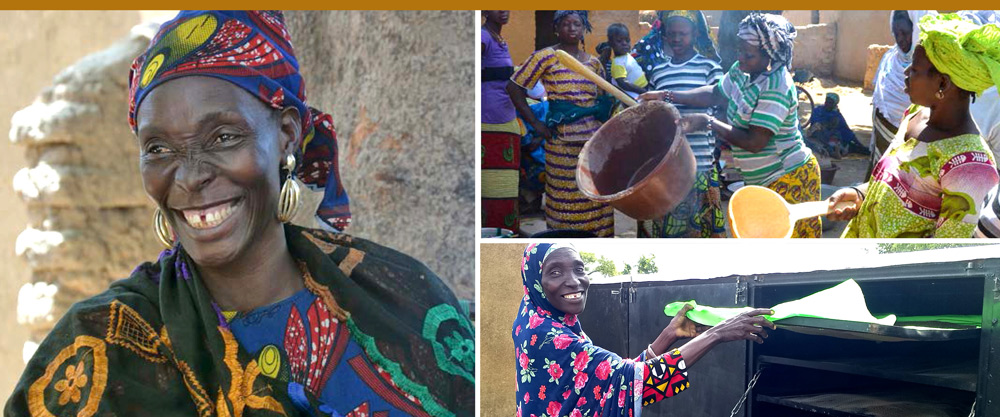
Left and bottom: Aminata Sanogo; Top right: Collective cooking of nutritious food at the N‘Golobougou village.
Aminata Sanogo is a 48-year-old woman farmer living in N’Golobougou, in the Dioïla district of Mali. A widow and mother of five, she is recognized as one of the leading women in her community. Her life and work demonstrate the importance of local knowledge, learning by doing, and community engagement, which can be just as crucial as formal education when it comes to taking on a leadership role.
More than ten years ago, she began cooking Tô, a pasty dish typical of the region using whole sorghum grains, without hulling them to remove the bran. In a society where women and girls are expected to spend a lot of time pounding grain, this practice of directly processing whole grains into food carried a social cost. “There’s a significant social stigma that prevents people from eating whole grains,” she explains. “If you eat the bran, it suggests that you must be really poor because you’re eating everything you can.” But Aminata knew that nearly half of essential micronutrients like iron and zinc are lost when grain is hulled—and that skipping the step freed up time for mothers to spend with their children. She also began teaching women in her neighborhood to prepare sorghum and millet dishes using unhulled grains or mixing them with cowpeas, a protein-rich legume.
She continued building her knowledge through the Kolanban cooperative, before joining JEKAFO cooperative, of which she is one of the main founders and now serves as secretary of external relations. The cooperative is a member of the local grain producers’ union (ULPC) which is responsible for implementing a research project coordinated by ICRISAT, “Networking for Seed.” Aminata, thus, became engaged in collaborative research with technicians and researchers where she developed expertise in seed production, sorghum and groundnut variety trials, and sustainable agricultural practices. She now serves as a knowledge-sharing liaison within her cooperative and on the N’Golobougou seed management committee. “The collaboration between producers and researchers has allowed us to better understand seed production techniques, to know the difference between open-pollinated and hybrid varieties, and to be able to sell the seeds without difficulty to other producers,” she says. “Today, women are more involved in the organization’s activities and actively participate in decision-making.”
Aminata has also pursued training in leadership, the GALS (Gender Action Learning System) approach, biofertilizer preparation, and agricultural processing, strengthening both her technical skills and her ability to support other women.
Today she holds several community roles: council member at the N’Golobougou town hall, chair of the local FNAFER chapter, nutrition liaison at the local health center for children and pregnant women, member of the women processors’ committee, and administrative secretary of the “Tekereni” savings and credit group. She also promotes literacy among women and youth and participates in community outreach through the local network of traditional communicators.
In addition to all of this, Aminata grows peanuts, rice, cowpeas, and vegetables on her own farm and sells at the weekly market in N’Golobougou demonstrating the full value of women farmers in agricultural production, community leadership, and governance.
Maïmouna Yonaba
Uprooted but Undefeated: A Woman Farmer Growing Hope in a Security-Challenged Zone in Burkina Faso
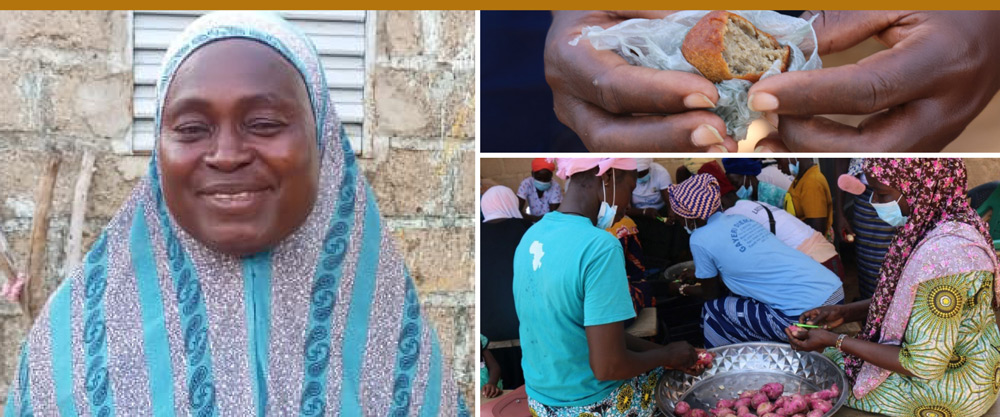
Clockwise from left: Maïmouna Yonaba; Sweet potato cakes; Collective processing and cooking
From Forced Displacement to Reconstruction
Maïmouna Yonaba is a native of Burkina Faso, a relatively arid area of the West African Sahel region located between the Sahara and the rainier zone further south. Over the past decade or so, the Sahel has been prey to insecurity that forced over 2 million people to be internally displaced and approximately 2.6 million to seek refuge in other countries.1 According to the United Nations High Commission for Refugees (HCR) and International Organization for Migration (IOM), Burkina Faso had approximately 2,062,534 internally displaced persons2, as per its June 2026 report. This situation also has negative implications on the food security of those affected, as is the case of Maïmouna Yonaba, an internally displaced woman from Eastern Burkina Faso.
Maïmouna Yonaba is a mother of seven children. Due to rampant security challenges prevailing in her region of origin over the past years, she had to flee with her family; which was yet a better lot compared to the unfortunate other fellows who did not have the chance to make it out and away safe and alive. As she is currently settled in the village of Mocomtonré (Diabo commune), she resolved to fight to feed her family. And this is where she crossed paths with ANSD, the Association Nourrir Sans Détruire, a Burkinabè organization dedicated to promoting agroecology, food and nutrition security, and the value addition of local agricultural products through capacity building for rural communities, particularly women.
Prior to the current experience, Maïmouna only knew how to boil or fry orange-fleshed sweet potatoes (OFSP). During harvest season, a large portion of the crop would rot due to a lack of good mastery of preservation and storing techniques. Thanks to support from ANSD, she and fellow women received training that taught them how to peel the sweet potatoes properly, slice them into very thin rounds, shred them, and then dry them. It is this shredded and dried product that can be stored for a long time. They then learned how to grind these dried pieces into a fine flour. The training taught them how to use the flour to diversify the diets of their households and for the market, particularly to prepare Tô, porridge for children, and, of course, cakes.
Beyond ensuring her family’s food security, Maïmouna has become an entrepreneur. With her potato cakes, she has won over the local market. “We sell at the market now, and people are surprised and ask, ‘Can you really make a cake out of that?’” she says proudly.
A group of 25 women focused on business
Faced with the challenge of accessing raw materials during this period, Maïmouna and women of her neighborhood have demonstrated remarkable organizational skills. They have formed a group of 25 women, pooling their meager resources through contributions to buy supplies directly from the market and keep their business running uninterruptedly.
A message of hope
Despite the difficult security situation, Maïmouna remains optimistic. She encourages all women to grow and process sweet potatoes: “With these preservation techniques, we can have the product available to eat or sell at any time.”
In this International Year of Women Farmers, Maïmouna’s story proves that with need-based capacity training, women are undoubtedly the pillars of food security, the health of their households, and the economies of their respective villages.
NOTES
1. United Nations High Commission for Refugees (HCR) and International Organization for Migration (IOM) (March 2026). https://data.unhcr.org/en/country/bfa
2. Secrétariat Permanent du Conseil national de secours d’urgence et de réhabilitation (SP-CONASUR) (2023).
Date:
7/7/2026